
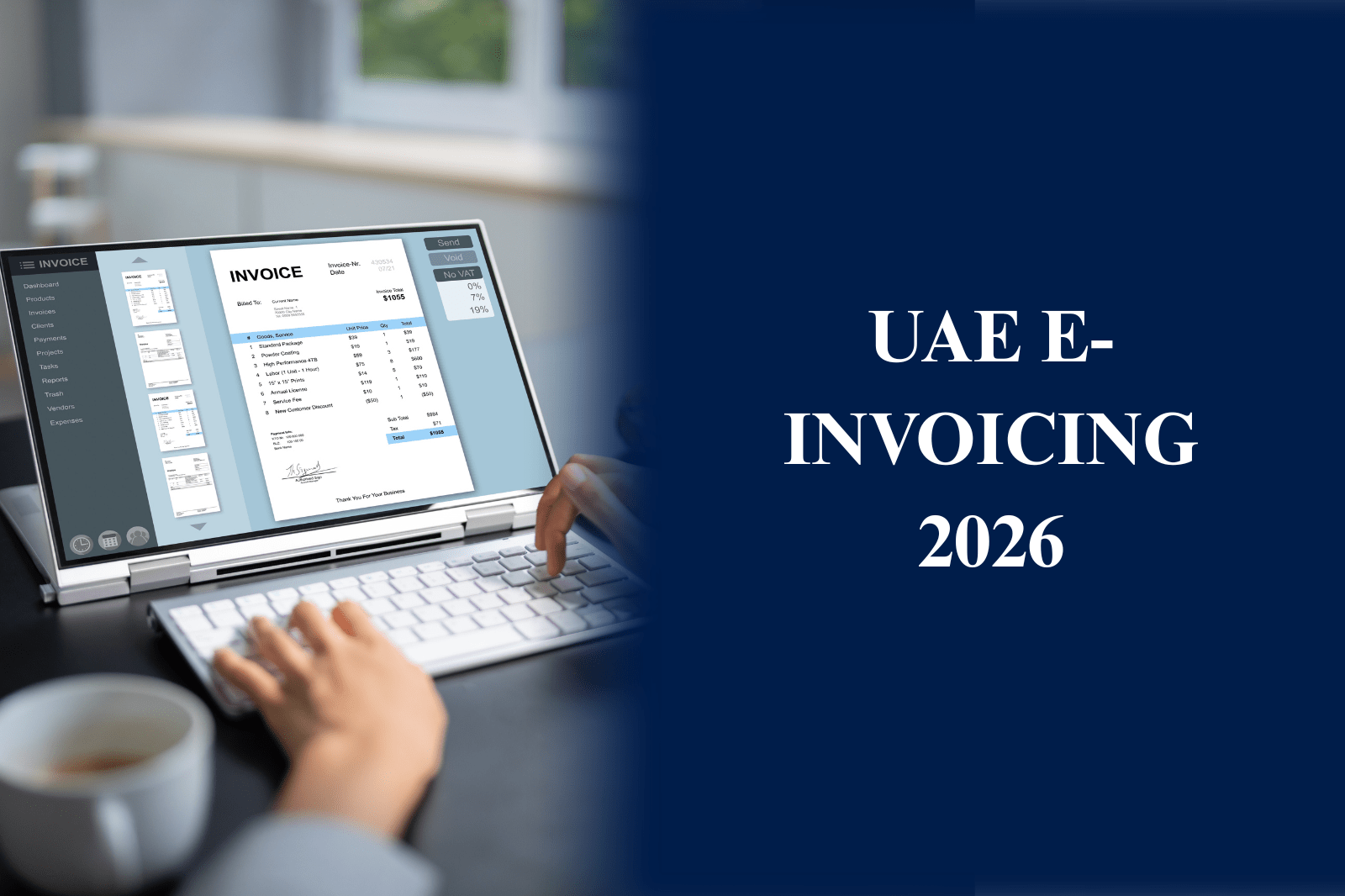


The UAE E-invoicing 2026 is a significant advancement towards a more intelligent and digitally driven economy. All UAE businesses are expected to use a new method of invoicing that enables invoices to be exchanged electronically between suppliers, customers, and tax agencies in a secure and uniform manner. The introduction of e-invoicing by UAE authorities is being done for several reasons, such as to provide greater transparency, reduce tax errors, speed up business operations, and digital transformation across different industries. Hence, businesses will now have quicker, safer, and more accurate means of managing their invoicing processes.
UAE’s move to electronic invoicing is consistent with the country’s mission of becoming a global digital business centre. Printed invoices are prone to delays, errors and compliance issues. Electronic invoicing provides businesses with an automated way of managing their finances and records. As a result of the shift toward electronic invoices, large organisations, SMEs and service organisations are required to be aware of compliance requirements, technical specifications, timelines and reporting requirements prior to implementing electronic invoicing fully. Preparation for implementation will help organisations operate efficiently and be compliant with UAE requirements.
What is E-invoicing in the UAE?
Businesses in the UAE will be able to generate, transmit, receive, validate, and store electronic invoices electronically through authorized e-invoicing software solutions. Businesses will send invoices electronically using standardized e-format documentation instead of paper invoices or common PDF files. The overall benefits of the process improves speed, accuracy, transparency, and VAT Compliance throughout the UAE market.
Key Points of UAE E-Invoicing
- Electronic vs. Manual Invoice Transmission
- Approved Online Platforms for the Electronic Exchange of Invoices
- Ability to Verify Invoice Information by the Government Agency in Real Time or Near Real Time
- Structured Electronic Format for Processing Invoice Data
- Reduction of Paperwork and Error of Manual Processing of E-Invoices
- Improvement of Transparency and VAT Compliance of E-Invoicing
- Improvement of Tracking of Invoices by Businesses
- Increased Protection of Finance Data Through the Use of Secure Technology
Why UAE Introduced E-Invoicing?
The UAE government introduced e-invoicing as part of their overall effort to promote economic prosperity and enhance the collection of taxes. Additionally, e-invoicing fits in with their overall plan for usage of innovative technologies and providing smart government solutions. Several important goals support the launch of e-invoicing.
- Diminishing fraudulent activity in relation to taxes and invoices
- Enhancing VAT compliance and the accuracy in reporting
- Reducing the time taken to get invoices approved and paid
- Minimising paperwork and reducing the overall cost of business operations
- Assisting businesses with their overall digital evolution
- Increasing the transparency of commercial transactions
- Building a stronger, more efficient economy
How UAE E-Invoicing Works?
The way e-Invoicing processes are conducted in the U.A.E. will be through a decentralized five-corner method. Businesses will send invoice files via an accredited service provider who will transmit them to the appropriate governmental agency, rather than submitting them directly through a web-based government platform. The main parties involved include:
- Supplier
- Purchaser
- Supplier’s accredited service provider
- Purchaser’s accredited service provider
- Federal Tax Agency and other government systems.
Key Features of UAE E-Invoicing System
Structured Electronic Documents
Invoices produced according to structured electronic formats must contain structured data that can be read and processed automatically by a software system. As such, invoices may no longer be in unstructured PDF formats.
Real or Near Real-Time Validation
Authorities can validate information in invoices at the point of issue or very shortly thereafter. It results in higher rates of compliance and fewer instances of fraudulent invoices.
Secure Exchange of Invoices
Invoices exchanged via accredited exchange platforms will be transmitted over secure communication channels, thereby safeguarding invoice and business information.
Standardised Data Elements
All entities must provide the required fields in the invoice according to standardised UAE-specific requirements. Standardisation of data elements will create a more uniform level of consistency between various industries.
Automated Processing Automation
Entities will be able to automate the processes of creating, approving, reporting and storing invoices. Consequently, it will reduce the amount of manual work performed by a company and improve overall efficiency in operations.
Businesses That Need To Prepare
At some point in the future all VAT registered businesses in UAE will most likely be required to comply with e-invoicing requirements. The following industries should prepare for e-invoicing implementation.
- Retail
- Manufacturing
- Logistics
- Healthcare
- Hospitality
- Professional Services
- Construction
- E-Commerce
- Wholesale and Trading
Difference Between Traditional Invoicing and E-Invoicing
| Traditional Invoicing | UAE E-Invoicing |
| Paper or PDF invoices | Structured electronic invoices |
| Manual data entry | Automated data processing |
| Higher risk of errors | Better accuracy |
| Slower approval process | Faster validation and processing |
| Difficult tracking | Real-time tracking |
| Higher storage costs | Digital storage |
| Limited transparency | Improved transparency |
Important Components of an E-Invoice
The e-invoicing system in UAE requires that businesses submit their e-invoices with all required standardized invoice information. Standard Invoice Components Include:
- Supplier Information
- Buyer Information
- VAT Registration Number
- Invoice Number
- Invoice Date
- Description of Each Product/Service
- Tax Amount Owed
- Total Amount of All Items/Services Invoiced
- Currency of Payment
- Payment Terms
Benefits of UAE E-Invoicing for Businesses
Faster Invoice Processing
The use of automated platforms cuts down on the time it takes to approve and process invoices because there is less human intervention in these processes.
Enhanced Compliance
Digital invoices will provide your organization with the ability to comply more effectively with VAT regulations than do traditional paper invoices due to their use of digital records and automated calculations for tax report preparation.
Cost Reduction
Your business will benefit from reduced expenses associated with printing, paper, shipping, storage, etc. The use of automation will also decrease the amount of administrative time spent creating, processing and reconciling invoices.
Increased Accuracy
Errors created through manual data entry are eliminated through automated invoice processing, thus providing greater accuracy of data used for processing all invoices.
Improved Financial Visibility
Your organization will have increased visibility into invoicing, payments and outstanding accounts receivable through the use of digital dashboards and reporting capabilities.
Enhanced Security
E-invoicing systems provide greater protection from loss of documents, fraud, and unauthorized changes to your invoicing process.
Challenges Businesses May Face
E-invoicing has many advantages, however there are also obstacles to e-invoicing for business when they get started.
System Upgrade and Replacement
Many businesses today use outdated accounting software. Companies may have to replace their old ERP system with a new ERP system or create an entirely new invoicing solution to meet their regulatory compliance requirements.
Employee Training
Finance and operational employees will need to be trained on how to use the new digital invoicing processes.
Integration Issues
The majority of businesses have multiple systems operating in disparate departments. Integrating accounting with their ERP and invoicing systems can often require some level of technical assistance.
Regulatory Compliance
Businesses must be aware of and conform to the growing number of regulatory changes, both to the technologies involved and to their reporting obligations.
Data Security
Companies must ensure that they safeguard their confidential financial data by using secure technologies and other best cybersecurity practices.
UAE E-Invoicing and VAT Compliance
Digital e-invoicing within the United Arab Emirates supports businesses in enhancing VAT compliance with the aid of digital validation of invoices and the automation of reporting. Electronic invoice methods provide increased levels of transaction tracking and reduced levels of manual error associated with VAT. In addition, possessing quality digital records assists businesses in developing VAT returns and in conducting audits. The Key Points are:
- Digital validation guarantees compliance with VAT and enables transaction tracking.
- Automated methods reduce errors in VAT reporting.
- Electronic records enable businesses to efficiently manage the VAT return process and successfully perform audits.
Technology Behind UAE E-Invoicing
Several technologies support the UAE e-invoicing framework.
Cloud Computing
Cloud computing allows users to access invoicing systems from multiple locations securely.
API Integration
APIs enable systems to interact automatically between their accounting and Enterprise Resource Planning (ERP) software.
Artificial Intelligence
AI technologies are used by some advanced systems for more efficient invoice matching, improved fraud detection, and automated workflows.
Data Encryption
Encryption technologies are used to secure confidential financial data when exchanged between parties during an invoice exchange.
How Businesses Can Prepare for UAE E-Invoicing?
Businesses should begin preparation early to avoid operational disruptions.
Examining Your Current Systems
Look At Your Accounting Software, ERP, Invoice Processing System.
Find out what gaps you have in Compliance
You will want to compare your current processes to those required by the UAE.
Select the right Partners for Technology
When selecting technology partners to implement e-invoicing, choose software vendors that have experience in that area and a good reputation.
Provide training for all staff
All staff working in finance, IT, and operations should have a good understanding of the digital invoice process. As well as the compliance requirements that apply to their departments.
Improve Data Accuracy
Before implementing e-invoicing, you will need to update your customer records, VAT numbers, and invoice templates.
Monitor Regulatory Updates
Authorities may release new technical guidance, timelines, and compliance procedures over time.
Impact on UAE Digital Economy
E-invoicing in the UAE is an enabler for broader economic modernisation goals with improvements in the speed and transparency of transactions improving both confidence in business activities and productivity. Digital E-invoicing provides the ability to support:
- Promoting the use of technology
- Increasing efficiency in conducting cross-border trade
- Supporting Smart Government initiatives
- Reducing financial fraud
- Increasing the confidence of investors
- Strengthening tax authority capabilities
Future of E-Invoicing in the UAE
E-invoicing is expected to become the norm for businesses in the UAE with time and more companies will transition toward automated financial systems and electronic tax procedures. Developments on e-invoicing are expected to be as follows:
- Further Automation Of Accounting Systems
- More Efficient Tax Reporting
- Use Of Ai To Monitor Finances
- Better Integration Between Businesses And Regulatory Agencies
- Enhanced Analytical And Reporting Capabilities
Conclusion
UAE E-Invoicing 2026 will drive the development of the future Digital Economy through a Major Focus by UAE to have Smarter and more Transparent Business Operations. The use of electronic invoicing will assist companies to increase compliance, streamline manual processes, and assist businesses in better accelerating their digital transformation. Companies who proactively prepare for UAE E-invoicing will gain efficiency benefits and improved financial management in the UAE marketplace.